Greek heroes were the bridge between the dirt of the earth and the gods of Olympus. They were mortals who possessed divine blood, walking the physical landscape of Greece and leaving monuments that the ancients could actually visit. Unlike the distant gods, heroes were accessible—they were ancestors, founders of cities, and the protectors of the land. What unites them is not a single origin, but the extraordinary stories that grew around their names, and the very human flaws they carried.
Heracles performed impossible labors, Perseus faced Medusa, Theseus entered the labyrinth, Achilles fought at Troy, and Jason sailed in search of the Golden Fleece. Others, such as Odysseus and Orpheus, became famous not simply for their strength but for intelligence, skill, or the power of their art.
What Was a Hero in Greek Mythology?
The ancient Greek idea of a hero was broader than the modern image of a perfect champion. A mythological hero could be courageous and deeply flawed at the same time. Heroes might defeat monsters, lead armies, found cities, rescue people or undertake journeys into places where ordinary mortals could not survive.
Some heroes were described as children of gods and mortals and are therefore often called demigods. But not every Greek hero had divine parentage. Odysseus, for example, was a mortal king, while Atalanta was a mortal heroine whose reputation rested on exceptional skill.
Heroic stories also tend to have a darker side. Success can bring suffering, exile, betrayal or death. Greek mythology rarely presents heroism as a simple matter of winning.
Heracles
Heracles, known to the Romans as Hercules, is perhaps the most famous of all Greek heroes. He was the son of Zeus and the mortal woman Alcmene, and his extraordinary strength became the defining feature of his legend.
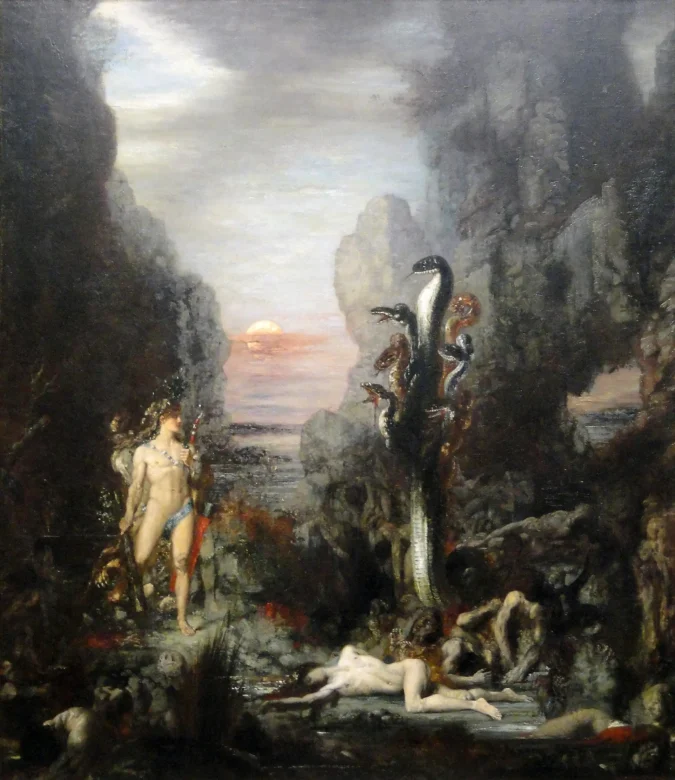
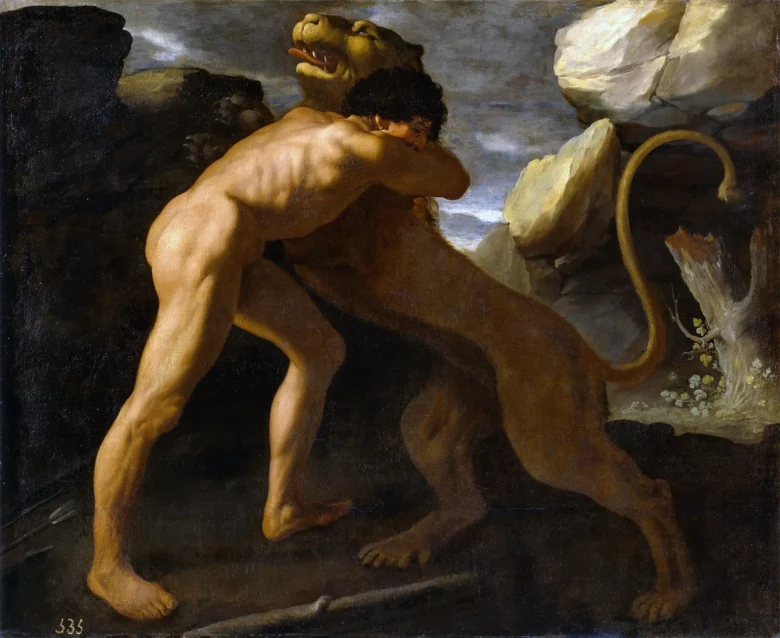
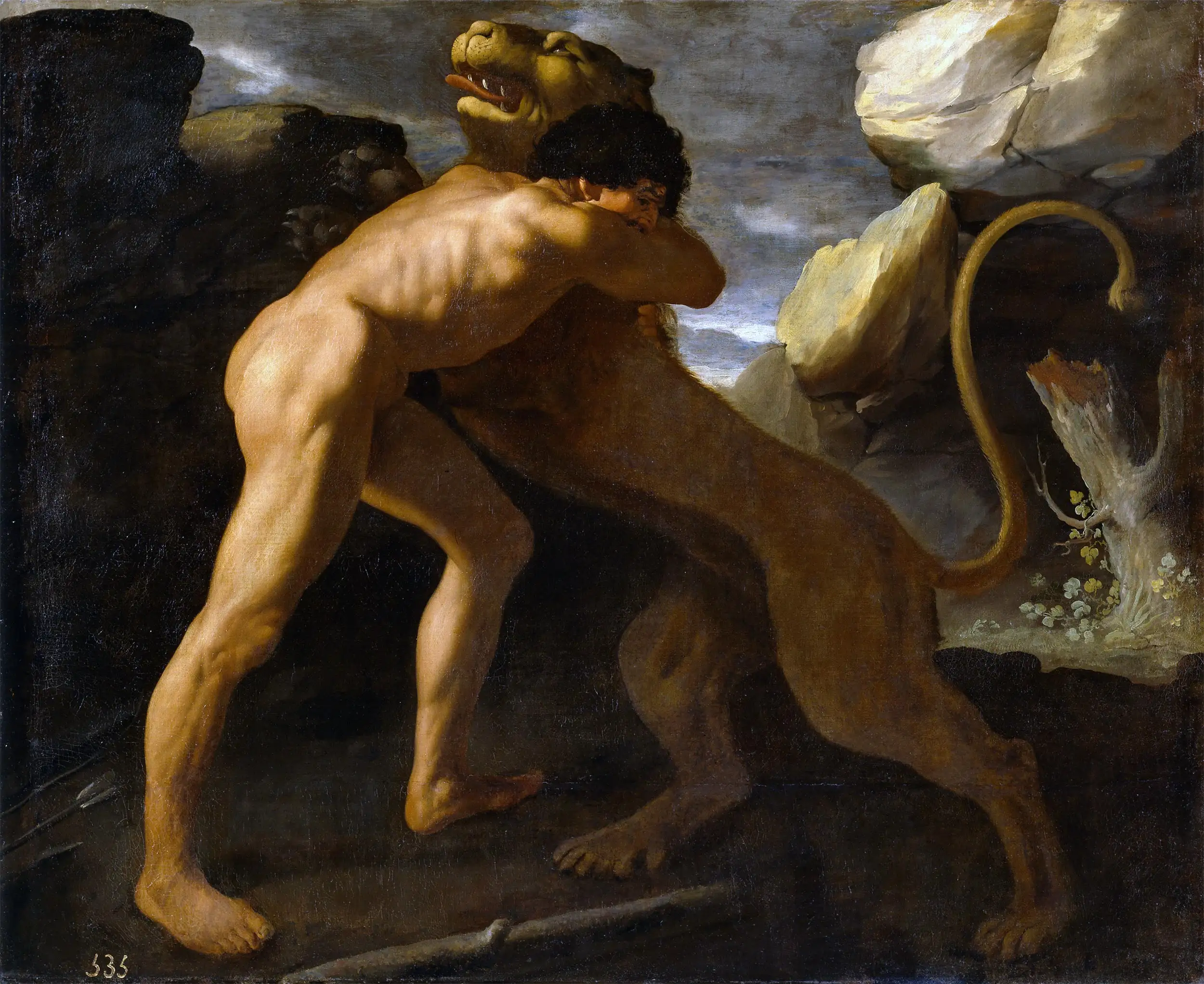
His greatest achievement was the series of Twelve Labors imposed upon him as a form of penance. He faced the Nemean Lion, the Lernaean Hydra, the Erymanthian Boar, and other seemingly impossible challenges. His adventures eventually took him to the edges of the known world and even into the Underworld.
Yet Heracles is not portrayed simply as an invincible strongman. His story includes madness, tragedy, guilt, and suffering. That mixture of enormous power and human vulnerability is one reason his legend survived for thousands of years.
Read more about Heracles and his Twelve Labors
Perseus
Perseus is best known for one of the most famous quests in Greek mythology: the killing of Medusa. The Gorgon could turn anyone who looked directly at her face to stone.
Perseus did not defeat her through strength alone. Athena gave him a polished shield, allowing him to approach Medusa while looking at her reflection rather than directly at her. After taking her head, he used it as a weapon and eventually rescued Andromeda, whom he married.
Perseus represents a recurring pattern in Greek heroic stories: the hero succeeds because courage is combined with intelligence and divine assistance.
Theseus
Theseus became one of the great heroes of Athens. His most famous adventure was his journey into the Cretan labyrinth, where he confronted the Minotaur, the monstrous offspring of Pasiphae and the Cretan bull.
With Ariadne’s help, Theseus found his way through the labyrinth after killing the creature. His adventures did not end there. He was also associated with numerous journeys and battles and eventually became a legendary king of Athens.
His story is particularly interesting because Theseus belongs not only to mythology but also to the legendary history that Athenians constructed around their city and its origins.
Achilles
Achilles is the greatest Greek warrior in Homer’s Iliad. He was the son of the mortal Peleus and the sea goddess Thetis, and his exceptional abilities made him one of the most formidable fighters at Troy.
But Achilles is not simply a story about military strength. The Iliad is deeply concerned with his anger, pride, friendship, and mortality. His conflict with Agamemnon leads him to withdraw from battle, while the death of Patroclus draws him back into the war with devastating consequences.
Achilles knows that glory and a long life cannot both be his. His choice gives the story much of its tragic power.
Jason and the Argonauts
Jason was the leader of the Argonauts, the group of heroes who sailed aboard the Argo in search of the Golden Fleece.
The expedition brought Jason into contact with a remarkable collection of heroes and dangers. Among them were Heracles, Orpheus, and the Dioscuri. Jason eventually reached Colchis, where the king demanded seemingly impossible tasks before surrendering the Golden Fleece.
Jason succeeded with the help of Medea, who used her knowledge of magic to protect him. Their later story, however, became one of the darkest relationships in Greek mythology. The tale of Jason therefore moves far beyond the conventional idea of the heroic quest.
Bellerophon
Bellerophon became famous for defeating the Chimera, a terrifying creature described as having the parts of several animals and breathing fire.
His greatest advantage was Pegasus, the winged horse. With Pegasus beneath him, Bellerophon attacked the Chimera from above and killed it.
His later story provides one of Greek mythology’s clearest warnings against excessive pride. After achieving extraordinary success, Bellerophon attempted to rise to the realm of the gods. His ambition ultimately brought about his downfall.
Odysseus
Odysseus, king of Ithaca and central hero of Homer’s Odyssey, represents a different kind of heroism. His greatest weapon is not physical strength but intelligence.
He is traditionally credited with the idea of the Trojan Horse, and after the fall of Troy, he spent ten years trying to return home. Along the way, he encountered the Cyclops Polyphemus, Circe, the Sirens, Scylla and Charybdis, and many other dangers.
Odysseus survives because he can adapt, deceive, and think his way out of situations that cannot be solved by force alone. His long journey home is one of the foundational adventure stories of Western literature.
Orpheus
Orpheus was not a warrior in the usual sense. His extraordinary power was music. According to myth, his playing was so beautiful that animals, trees, and even stones responded to it.
When his wife Eurydice died, Orpheus descended into the Underworld to bring her back. His music moved Hades and Persephone, who agreed to release her on one condition: he must not look back at her until they had completely returned to the world of the living.
Orpheus looked back too soon, and Eurydice was lost again. His story became one of the most powerful Greek myths about love, loss, and the limits placed on mortals even when the gods grant them an extraordinary opportunity.
Atalanta
Atalanta is one of the most distinctive heroines of Greek mythology. A skilled hunter and exceptionally fast runner, she refused to accept the conventional role expected of women in many heroic traditions.
She joined the hunt for the Calydonian Boar and became one of the participants in the Argonaut expedition in some traditions. Her most famous story concerns a footrace: she agreed to marry only a man who could defeat her in a race.
Hippomenes eventually succeeded by using golden apples supplied by Aphrodite to distract her. Like many Greek myths, the story combines exceptional ability with desire, divine intervention and consequences that follow later.
Castor and Polydeuces
Castor and Polydeuces, known together as the Dioscuri, were the twin brothers of Helen of Troy and Clytemnestra. Their parentage is unusual: Polydeuces was the son of Zeus, while Castor was the mortal son of Tyndareus.
The brothers were renowned for different abilities. Castor was associated with horsemanship, while Polydeuces was an exceptional boxer. Their bond became the heart of their story, particularly after Castor’s death.
Zeus eventually allowed the brothers to share immortality, so that they could alternate between the Underworld and Olympus. Their story became an enduring example of brotherly devotion.
Meleager
Meleager was the central hero of the hunt for the Calydonian Boar, a monstrous animal sent to ravage the land of Calydon.
A group of famous heroes joined the hunt, including Atalanta. Meleager eventually killed the boar, but the dispute over its spoils led to further violence and tragedy.
His story is another reminder that Greek heroic mythology does not end when the monster is defeated. Family, pride, and anger can be just as dangerous as the creature itself.
The Heroes of Greek Mythology
The great Greek heroes are remarkably different from one another. Heracles represents physical strength and endurance. Perseus combines courage with cleverness. Theseus becomes a legendary figure of Athens. Achilles embodies martial excellence and tragic mortality. Odysseus survives through intelligence, while Orpheus enters the Underworld through the power of music.
Some are descendants of gods, some are kings, some are warriors, and some are outsiders. Their stories therefore give Greek mythology a human dimension that the stories of the gods alone cannot provide.
And unlike the gods, most heroes cannot escape the consequences of being mortal. Their victories may become immortal, but their lives remain marked by loss, fate and death.
Their stories aren’t just fantasy. They were the foundation of Greek identity, a way for the city-states to claim descent from the gods and to legitimize their rule over the land.