The labors of Heracles were not just tests of strength; they were a geographical tour of the ancient Greek world. From the marshes of Lerna to the mountains of Nemea, Heracles was a mortal who walked the earth, protecting civilization from the wild forces of nature. But his story is not simply the story of a hero who completes twelve impossible tasks. It is the story of a man who repeatedly falls, suffers the consequences, and continues. That combination of enormous strength and human weakness is what makes Heracles one of the most enduring figures in Greek mythology.
Who Was Heracles?
Heracles was the son of Zeus and Alcmene, a mortal woman. Zeus disguised himself as Alcmene’s husband Amphitryon and fathered Heracles during his absence.
Hera, Zeus’s wife, was hostile toward Heracles from before his birth. Heracles therefore grew up under the shadow of Hera’s anger. His divine parentage gave him extraordinary abilities, but being the son of Zeus did not make his life easy or free him from suffering.
Heracles eventually married Megara, but his life took a terrible turn when Hera caused him to fall into a state of madness. In that madness, he killed his wife and children. When he recovered and understood what he had done, he sought a way to atone for the crime.
The resulting punishment would become the foundation of the greatest heroic cycle in his mythology.
The Twelve Labors of Heracles
Heracles was ordered to serve Eurystheus, king of Tiryns, and perform a series of extraordinary tasks. The stories were later organized into the famous Twelve Labors.
The tasks were deliberately beyond the ability of an ordinary mortal. Some required Heracles to defeat monsters, others to capture dangerous animals, and others to travel to distant or supernatural places.
1. The Nemean Lion
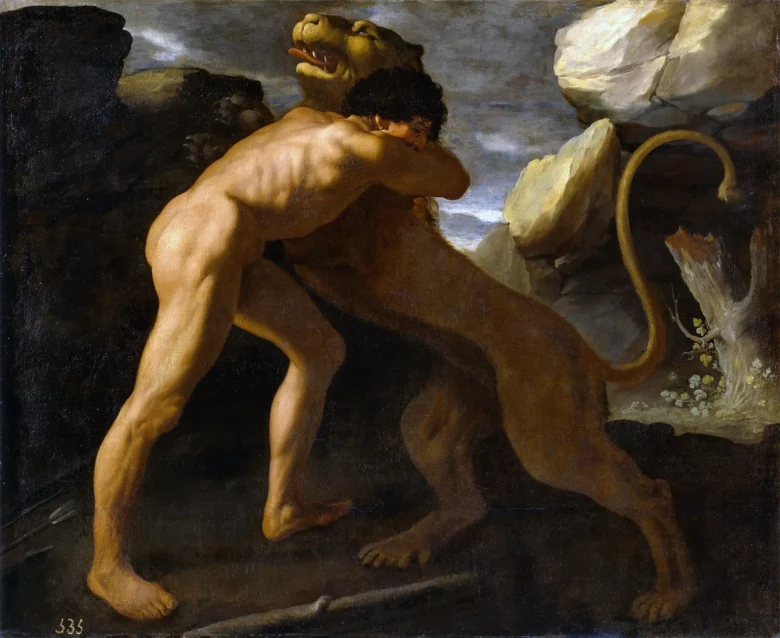
The first labor was to kill the Nemean Lion, a monstrous animal whose hide could not be pierced by ordinary weapons.
When his arrows and other weapons failed, Heracles confronted the lion directly and strangled it. He then used the creature’s own claws to cut through its otherwise impenetrable hide and wore the skin as armor.
2. The Lernaean Hydra
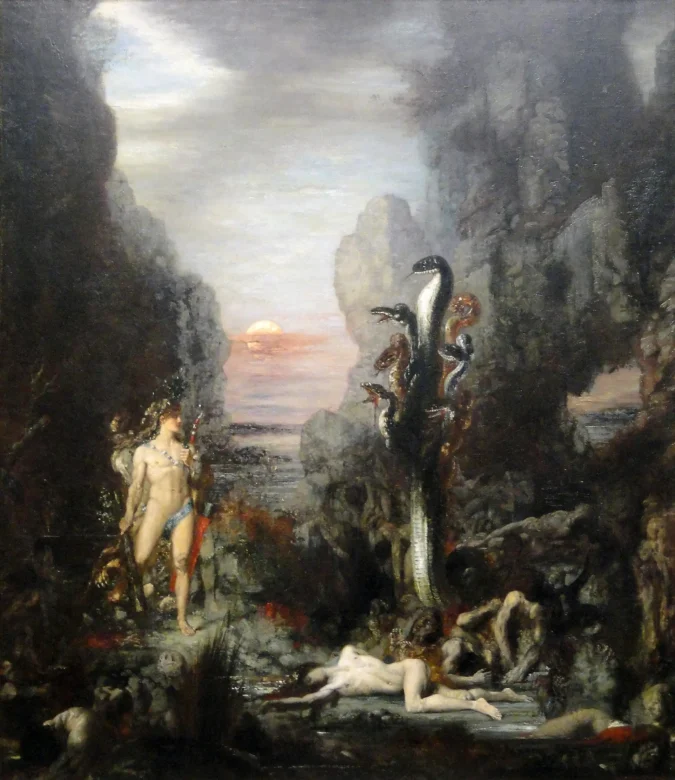
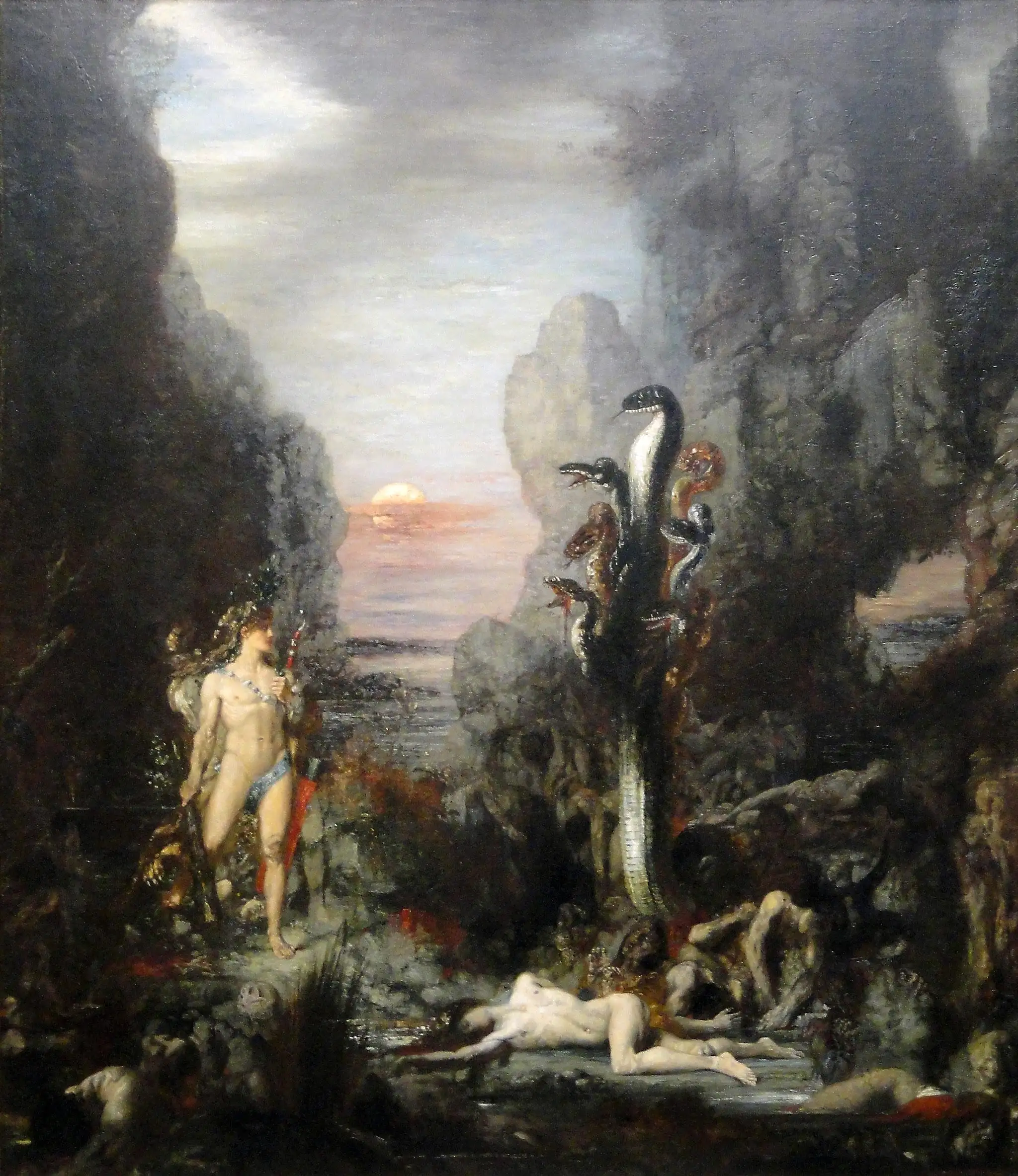
The second labor took Heracles to Lerna, where the Hydra lived. This enormous serpent had multiple heads, and cutting off one head caused others to grow in its place.
Heracles was assisted by his nephew Iolaus. After Heracles cut off each head, Iolaus cauterized the wound with fire so that it could not regenerate. The immortal central head was finally buried beneath a huge rock.
3. The Ceryneian Hind
For his third labor, Heracles was ordered to capture the Ceryneian Hind, a sacred deer associated with Artemis. Unlike the previous labors, the challenge was not simply to kill a monster but to capture the animal alive.
Heracles pursued it for a long time before finally catching it. The story also required him to avoid offending Artemis, whose sacred animal he had captured.
4. The Erymanthian Boar
The fourth labor was to capture the enormous Erymanthian Boar. Heracles drove the animal into deep snow, where he was able to overpower it and carry it back alive.
This labor is also connected with the centaur Pholus and one of the recurring disasters surrounding Heracles’s adventures.
5. The Augean Stables
The fifth labor was very different. Heracles was ordered to clean the enormous stables of King Augeas, which had not been cleaned for years.
Instead of attempting the impossible task by hand, Heracles redirected the rivers Alpheus and Peneus through the stables. Their waters swept away the accumulated filth in a single day.
The story is important because Heracles succeeds through ingenuity rather than strength alone.
6. The Stymphalian Birds
The sixth labor took Heracles to the region of Lake Stymphalus, where dangerous birds had gathered in enormous numbers.
The birds had metallic feathers and were difficult to approach. With the help of a divine rattle or clapper given to him by Athena, Heracles frightened them into the air and then drove them away, killing some with his arrows.
7. The Cretan Bull
Heracles was then sent to capture the Cretan Bull, a powerful animal associated with Crete and with the mythological history of the Minotaur.
Heracles captured the bull alive and brought it back. Eurystheus later released it, and the animal continued its destructive wandering until it was eventually confronted by another hero.
8. The Mares of Diomedes
The eighth labor involved the terrifying horses of Diomedes, king of the Bistones in Thrace. The horses were wild and, in the best-known versions of the story, fed on human flesh.
Heracles seized the animals and overcame their master. The mares were eventually brought to Eurystheus, completing another task that had been intended to be impossible.
9. The Belt of Hippolyta
For the ninth labor, Heracles was sent to obtain the belt of Hippolyta, queen of the Amazons.
The story varies significantly between ancient and later accounts. In one tradition Hippolyta was willing to give Heracles the belt, but Hera stirred conflict among the Amazons and caused the situation to turn violent.
Heracles eventually took the belt and returned with it. The episode became one of the most famous encounters between the Greek hero and the Amazons.
10. The Cattle of Geryon
The tenth labor took Heracles to the far western edge of the mythological world to obtain the cattle of Geryon, a monstrous figure described as having three bodies or three joined forms.
Heracles had to cross vast distances and confront both Geryon and his herdsman. After completing the task, he drove the cattle back toward Greece, and the journey became one of the great long-distance adventures of his mythology.
11. The Apples of the Hesperides
The eleventh labor sent Heracles to obtain the golden apples of the Hesperides. The apples belonged to the gods and were guarded by a serpent or dragon, while the Hesperides themselves watched over the sacred garden.
The traditions surrounding this labor differ. In one famous version, Heracles persuaded Atlas to retrieve the apples while Heracles temporarily carried the heavens. He then used a trick to persuade Atlas to take the burden back.
The story places Heracles at the edge of the known world and connects his adventures with the older Titan generation.
12. Cerberus
The final labor was perhaps the most extraordinary of all: Heracles had to descend into the Underworld and bring back Cerberus, the monstrous hound guarding its entrance.
Hades allowed Heracles to take Cerberus on the condition that he subdue the creature without using weapons. Heracles accomplished the task through his strength and brought the three-headed hound to the world above.
After showing Cerberus to Eurystheus, Heracles returned the creature to the Underworld.
Why Did Heracles Perform the Labors?
The Twelve Labors are often presented simply as a list of heroic achievements, but their origin lies in a much darker part of Heracles’s story.
After killing his family during a divinely induced madness, Heracles needed purification and atonement. The precise details vary among ancient sources, but the tradition ultimately connects his service to Eurystheus with his attempt to deal with the consequences of his terrible act.
This gives the Labors a different meaning. Heracles is not merely collecting victories. He is trying to live after committing an act that cannot be undone.
Heracles Beyond the Twelve Labors
The Twelve Labors are only part of Heracles’s mythology. He took part in numerous other adventures and expeditions, fought kings and monsters, and joined the Argonauts in some traditions.
He also fought against the Giants in the Gigantomachy and played a role in the legendary conflict between the gods and their enemies. His strength made him a powerful ally of the Olympians.
Heracles’s life remained turbulent, however. His marriages and relationships brought further tragedy, and his temper repeatedly led to violence.
Heracles and Deianeira
Heracles eventually married Deianeira. Their story became the final great tragedy of his mortal life.
Deianeira had been told that the blood of the centaur Nessus could act as a love charm. When she later feared that Heracles was attracted to another woman, she used the substance on a garment intended for him.
But Nessus’s blood was poisoned. When Heracles put on the garment, he suffered unbearable pain as it clung to his body. Deianeira realized too late what had happened.
Heracles understood that death was approaching and ordered a funeral pyre to be built on Mount Oeta.
The Apotheosis of Heracles
Heracles’s death is unusual because it does not represent the end of his story. After his mortal body was consumed by the fire, Zeus brought Heracles to Olympus, where he became immortal.
Heracles was therefore transformed from a suffering mortal hero into a god. In later tradition he became associated with strength, protection and heroic achievement, and he received worship in both heroic and divine contexts.
His apotheosis gives his story a remarkable final movement: the man who spent his life suffering the consequences of divine conflict eventually becomes part of the divine world himself.
Heracles in Greek Mythology
Heracles is often reduced to his physical strength, but the complete mythology is much more complicated. He is the son of Zeus but spends much of his life suffering because of Hera. He is a celebrated monster-slayer but also commits an unforgivable act in a moment of madness. He performs extraordinary labors yet repeatedly faces failure, grief and punishment.
That contradiction is central to his character. Heracles is powerful enough to defeat the Nemean Lion, the Hydra and Cerberus, but he cannot simply overpower fate or erase the consequences of his actions.
But his story ends in tragedy. The greatest hero of them all was ultimately destroyed by his own nature, proving that in the Greek worldview, mortality—and fate—could not be escaped, no matter how strong you were.