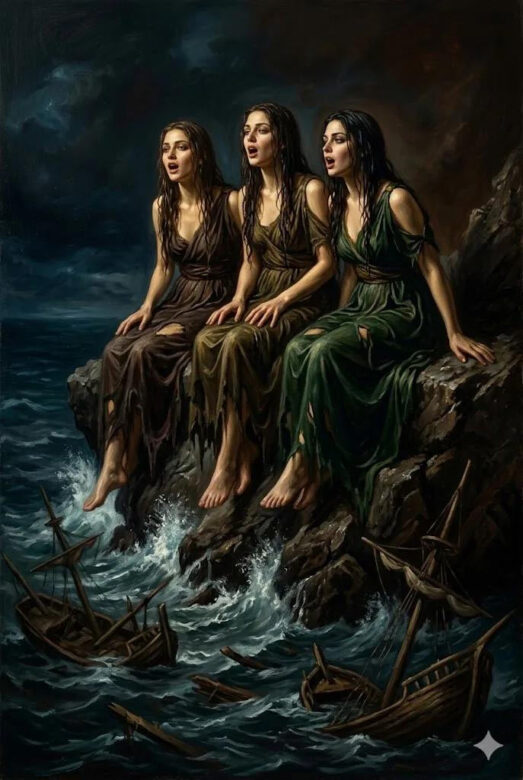
Before they were ‘Greeks,’ they were Hellenes. To understand this shift in identity, you have to look at the sea. It was the Aegean that connected the disparate tribes and city-states, creating a shared culture that the Romans later called ‘Graecia’. The name ‘Hellas’ and ‘Hellenes’ is a legacy of a seafaring people who defined themselves not by borders, but by language, myth, and the shared waters of the Mediterranean.
Hellas is the land of the Hellenes. In other words, it is the land of the people whom the world usually calls Greeks. But why do Greeks call themselves Hellenes? And where did the name come from?
The question is often asked the other way around: why do we call Hellas “Greece”? That is actually the more interesting question, because Hellas, Hellenes, and Hellen are not modern inventions. They reach back into the mythology and history of the ancient Greek world.
There is also an easy trap here. The name Hellen has nothing to do with Helen of Troy. They are different figures, despite the similarity of their names.
The story becomes even more interesting when mythology, ancient tribal identities, language, and the later Roman name for the Greeks are placed next to each other.
Who Was Hellen?
In Greek mythology, Hellen was the son of Deucalion and Pyrrha. He is traditionally presented as the ancestral figure from whom the Hellenes took their name.
That does not mean that an actual historical man named Hellen founded the Greek people. This is mythology doing something mythology often does: creating a single ancestral figure to explain the identity of a much larger and more complicated people.
The ancient Greeks had different communities, dialects and traditions. Yet mythology could connect them through a common ancestor.
Hellen was therefore given four sons in the traditional genealogy: Aeolus, Dorus, Xuthus, and Ion.
From them came the traditional ancestral lines of the Aeolians, Dorians, Achaeans, and Ionians.
Whether we regard this genealogy as history or mythology, its purpose is revealing. It explains how different Greek peoples could see themselves as belonging to one larger Hellenic world.
The Mythological Origin of the Hellenes and Hellas
The story of Hellen begins with one of the most famous Greek myths: the Flood of Deucalion.
It is worth remembering that ancient Greek mythology does not separate myth and history in the same way that modern historians do. A myth could preserve ideas about ancestry, places and peoples without being a historical record in the modern sense.
Long before the name Hellenes became associated with all Greeks, the Aegean world already contained flourishing societies.
The Cyclades had developed complex communities thousands of years before classical Greece. Crete produced the civilization we now call Minoan, while the Mycenaean world later became the first clearly identifiable Greek-speaking civilization known from written evidence.
The relationship between these earlier populations and the later Greeks is not as simple as an uninterrupted story from one civilization to another.
Linear A, associated primarily with Minoan Crete, remains undeciphered. Linear B, used by the Mycenaeans, is different: it has been deciphered and records an early form of Greek.
That distinction matters. We can read Greek names and words in Linear B, but we cannot simply assume that every earlier Aegean population was “Greek” in the same sense.
The ancient myths tell a much simpler story.
They begin with the flood.
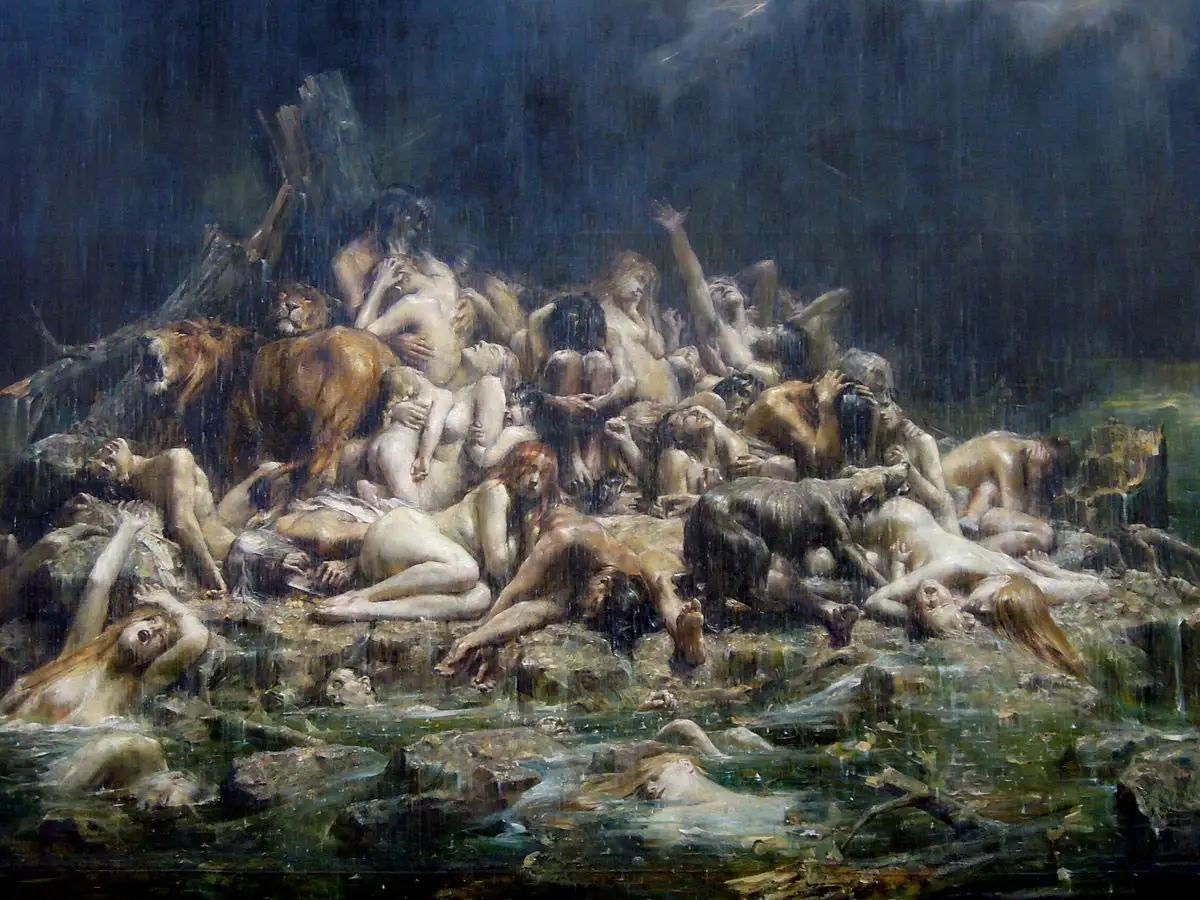
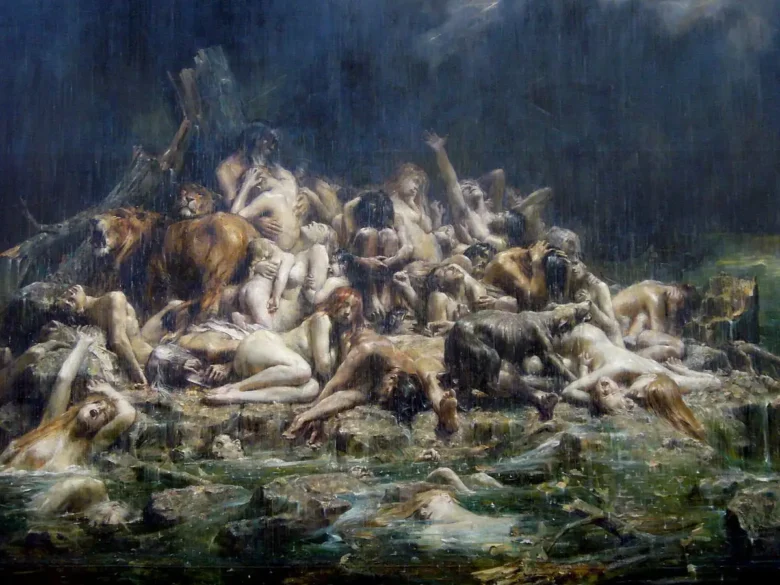
The Flood of Deucalion
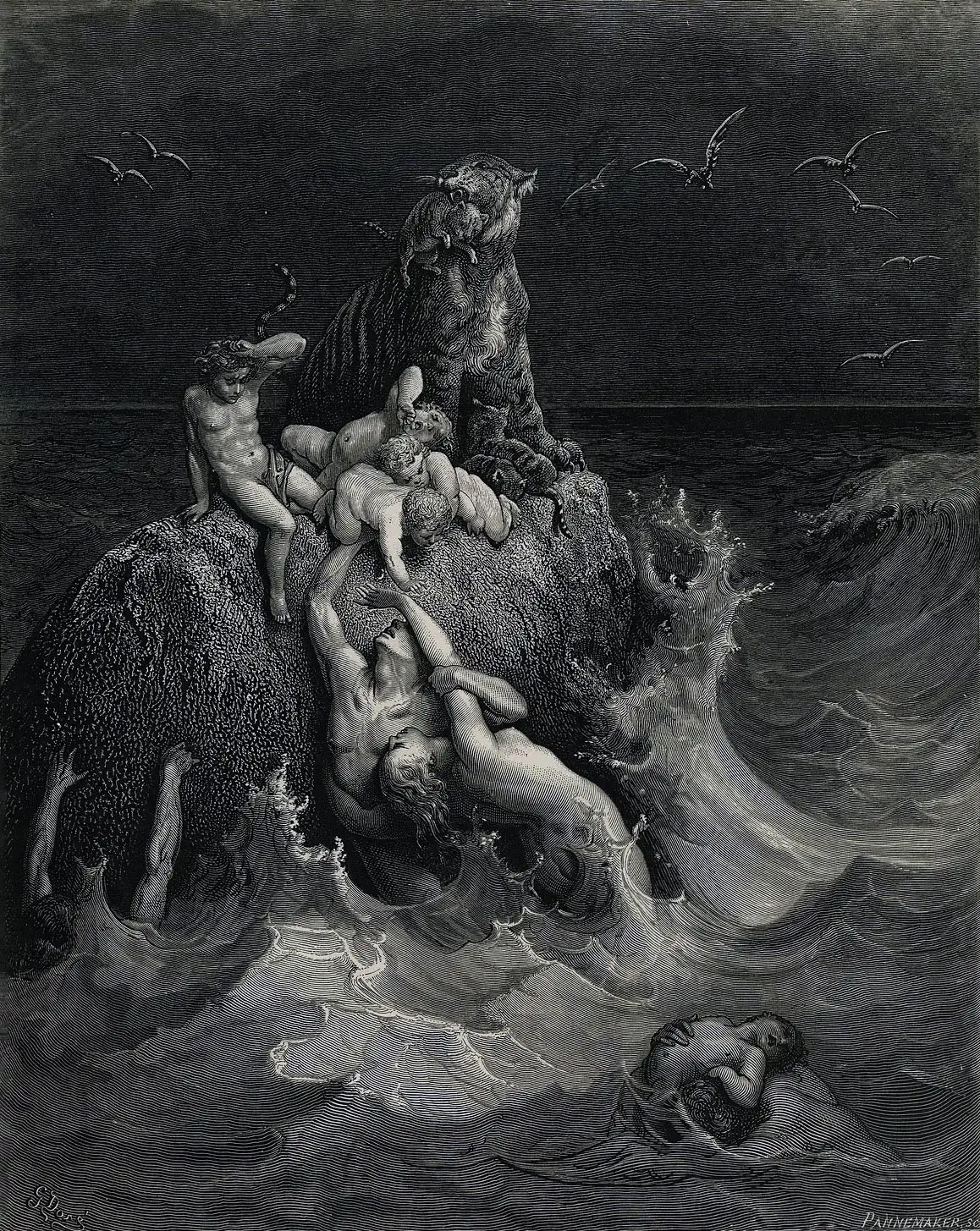
According to the Greek tradition, a catastrophic flood destroyed much of humanity. Deucalion and Pyrrha survived and eventually came to rest on Mount Parnassus.
Deucalion was the son of the Titan Prometheus, while Pyrrha was the daughter of Epimetheus and Pandora in the traditional genealogy.
The two survivors were then given an extraordinary instruction. They were told to throw stones behind them.
The stones became people.
This is one of those myths that sounds strange when read literally but becomes much more interesting when viewed as a story about the rebirth of humanity.
Deucalion and Pyrrha were not simply survivors of a flood. They became the beginning of a renewed human population.
And one of the people born from those stones was Hellen.
How Were the First Hellenes Born?
The story says that the stones thrown by Deucalion became men, while those thrown by Pyrrha became women.
The first man produced by Deucalion was Hellen, and from Hellen came the traditional ancestral lines of several major Greek peoples.
His sons and descendants were associated with the Aeolians, Dorians, Ionians, and Achaeans.
This is where the meaning of Hellenes becomes more interesting than the simple statement that “Hellen was the ancestor of the Greeks.”
The genealogy is a mythological explanation for unity among people who were not necessarily politically or culturally identical.
The Greeks were never one homogeneous ancient population ruled by one king. They lived in different regions, spoke different Greek dialects and belonged to different communities.
Yet the idea of a common Hellenic ancestry provided a way of explaining what they had in common.
Hellen and Helen of Troy Are Not the Same Person
There is an obvious source of confusion.
Hellen, the legendary son of Deucalion, is not Helen of Troy, the woman whose abduction is traditionally associated with the Trojan War.
The names are similar in English, but they belong to different mythological traditions and refer to different figures.
This distinction becomes particularly important when discussing the meaning of the word Hellenes.
The Hellenes did not take their name from Helen of Troy.
The traditional mythological ancestor is Hellen.
So What Does “Hellenes” Actually Mean?
The word Hellenes eventually became the name by which Greeks described themselves.
But it did not necessarily have exactly the same meaning at every point in ancient history.
This is one reason why the simple version of the story can be misleading.
Ancient Greek identity developed over centuries. Different groups identified themselves through their city, region, tribe and local traditions. The word “Hellenes” gradually acquired a wider meaning, particularly as the idea of a common Greek identity became more important.
By the classical period, the term could refer broadly to Greek-speaking peoples in contrast with non-Greek peoples, commonly described as barbarians.
In that sense, “Hellenic” became more than a family name from mythology. It became a cultural identity.
Then Why Is Greece Called Greece?
This is where the story takes an unexpected turn.
If the Greeks call their country Hellas and themselves Hellenes, why does most of the world call the country Greece?
The answer does not require a mysterious renaming of Hellas.
The international word comes through the Latin Graecia and Graecus, terms that were adopted into many European languages.
The Romans encountered Greek peoples under names that included forms of Graeci. The Latin term then became the source of the familiar words for Greece and Greeks in many later European languages.
This is why English has Greece and Greeks, while modern Greek has Hellas and Hellenes.
Neither word is a modern invention.
They are two different linguistic histories that survived side by side.
Did the Romans Rename Hellas?
This is where many popular explanations go too far.
It is tempting to imagine a deliberate Roman decision to erase the name Hellas and replace it with Greece. The history is more complicated.
The Latin name did not simply appear because somebody officially decided that the Greek name had to disappear. Different names existed in different languages and contexts, and Latin usage had its own history.
Later, the words derived from Graecus spread throughout Europe and eventually became the normal names for the country and its people in many languages.
At the same time, Hellas never disappeared from the Greek language.
In fact, it is the official Greek name of the country today.
Why Do Greeks Still Call Their Country Hellas?
There is therefore no contradiction between Greece and Hellas.
They are simply different names that developed through different linguistic traditions.
A Greek person speaking Greek does not normally say “Greece” when referring to the country. The word is Ελλάδα in everyday speech and Ελλάς in the formal form.
Likewise, Έλληνας means a Greek man and Ελληνίδα a Greek woman.
The international word “Greek” tells us something about the history of the word used by other languages.
The word “Hellenes” tells us something about how Greeks describe themselves.
Neither makes the other false.
Is Greece Named After Hellen?
In the mythological tradition, Hellas is connected with Hellen, the son of Deucalion.
That does not mean that historians can establish Hellen as a historical founder of the Greek people.
This is an important distinction.
The mythology gives the Greeks an ancestral explanation for their name. Archaeology and historical linguistics tell a much more complicated story about the formation of the Greek-speaking world.
The two should not be forced to give the same answer.
Mythology explains identity in the language of ancestors and stories. History asks what can be demonstrated from surviving evidence.
Were the Hellenes Always Called Greeks?
No.
They were not always called “Greeks” in the English sense because English did not yet exist.
That sounds obvious, but it explains much of the confusion.
Every language has its own names for foreign peoples. A people can have one name for themselves and another name in a neighboring language.
That happens all over the world.
The Greeks are simply a particularly striking example because their own ancient name, Hellenes, survived continuously into the modern language, while the Roman-derived name became dominant internationally.
So when we say “Greeks” in English and “Hellenes” in Greek, we are not necessarily choosing between two competing identities.
We are looking at two different linguistic traditions describing the same people.
Hellenes, Hellas and the Meaning of Greek Identity
Perhaps the most interesting part of the story is not which name is “correct.”
It is that both names survived.
Hellen belongs to mythology.
Hellenes became a name for the Greek people.
Hellas became the Greek name for their country.
Graecus gave much of Europe its word for the Greeks.
And Helen of Troy belongs to an entirely different story.
Once these names are separated, the apparent confusion becomes much easier to understand.
The Greeks did not suddenly become Greeks because somebody changed their name. The world simply inherited a different name for them.
Today, the modern Greek state still carries the name of the Hellenes, a legacy that stretches back to the mythic ancestor Hellen. But the deeper connection is the sea itself. The modern Greek shipping industry and the ferries that connect the islands are the modern echo of the ancient Hellenic identity—a people forever tied to the water.