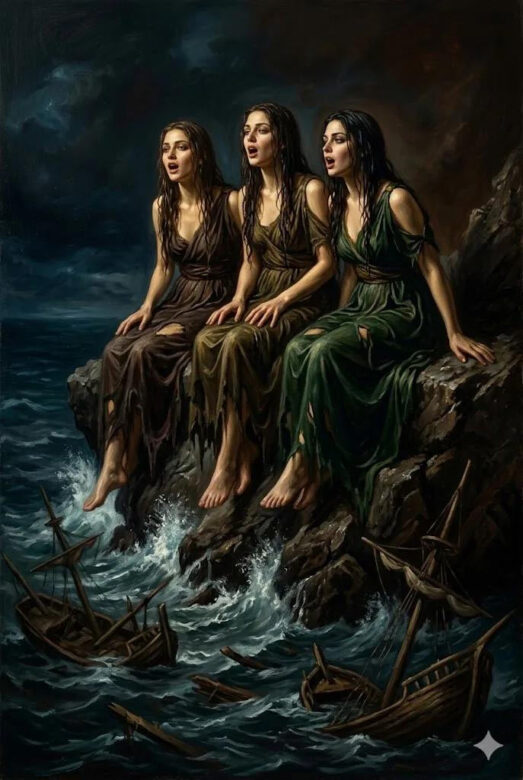
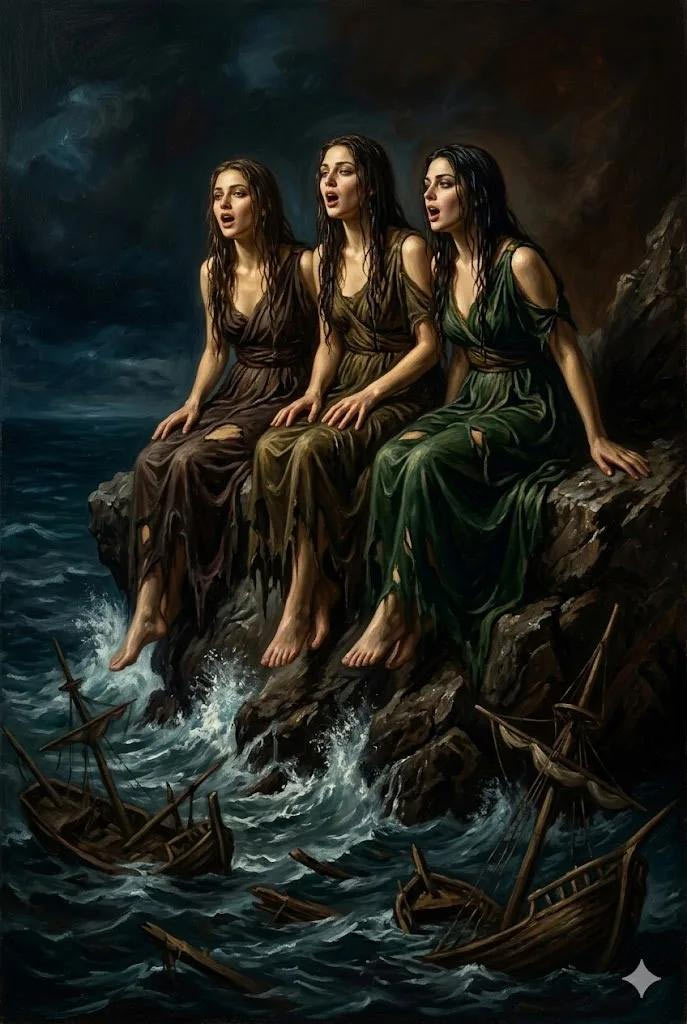
The Sirens are one of the most misunderstood figures in Greek mythology. We picture them as mermaids—beautiful women with fish tails, luring sailors with seductive songs. But the original Sirens of the Odyssey were something far stranger, and far more terrifying: bird-bodied women, perched on a meadow of bones, whose song promised not pleasure, but knowledge.
This is the story of why the Greeks feared the sea’s song, and what it reveals about the dangers of the deep.
The Original Sirens Were Not Mermaids
Homer gives no physical description of the Sirens in the Odyssey. They are simply “the twin Sirens,” their voices carrying across the water. The image of the mermaid—the seductive fish-tailed woman—is a much later invention. It emerged during the Middle Ages, shaped by Celtic folklore and the influence of sea gods like Triton, and it eventually replaced the older, stranger form.
The original Sirens were bird-bodied creatures, women from the waist up but with the wings, claws, and tail of a bird. In ancient Greek art, they appear on grave markers and funerary plaques, crouched beneath funeral couches, associated not with erotic temptation but with death itself.
They were liminal creatures—caught between earth and air, between the human and the animal, between the living and the dead. Their wings marked them as creatures of the boundary. Their connection to the sea placed them at the edge of the known world.
What the Song Actually Promised
Circe’s warning to Odysseus is precise: “There is no homecoming for the man who draws near them unawares and hears the Sirens’ voices; no welcome from his wife, no little children brightening at their father’s return”.
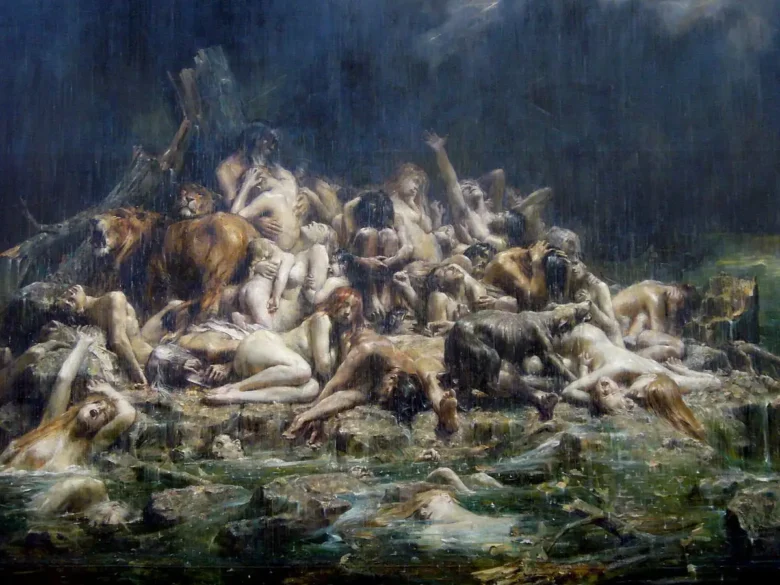
But what did the song say? Homer does not tell us directly. He tells us only that the Sirens sit in a meadow “piled high with the mouldering skeletons of men, whose withered skin still hangs upon their bones”. The song is not described because the song is whatever you want to hear.
The Sirens promise knowledge. They promise the answer to the question you have been carrying your whole life. For Odysseus—a man who has spent ten years fighting and ten years trying to get home—the song offers what he cannot resist: the truth about his own story. He wants to hear how it ends. He wants to know if he will ever see Ithaca again.
This is why the Sirens are so dangerous. They do not tempt you with pleasure. They tempt you with understanding. And the price of understanding is your life.
Odysseus and the Art of Listening
Odysseus’s solution is one of the most famous acts of cunning in Greek myth. He does not avoid the Sirens. He does not kill them. He listens to them and survives.
He orders his crew to plug their ears with beeswax, so they cannot hear the song. But he himself—driven by curiosity, by the hunger for knowledge that defines him—asks to be tied to the mast. He wants to hear what the Sirens have to say. He wants to know.
The crew binds him hand and foot. When the song begins, Odysseus is overwhelmed. “My heart was filled with such a longing to listen that with nod and frown I signed to my men to set me free” . But the crew, following their earlier instructions, tighten the bonds instead. They row on. The song fades. Odysseus survives, but he has heard something no mortal has heard and lived.
This is the Greek lesson about the sea: you cannot conquer it, but you can outwit it. The sea is not a place of simple danger. It is a place of seduction, of knowledge, of the terrible beauty that lies just beneath the surface.
The Sea as the Greeks Knew It
The ancient Greeks were a seafaring people, but they did not romanticize the water. The sea was the highway, the source of wealth, and the ultimate threat . It was how you reached other lands, traded, and built an empire. It was also where you died.
The Sirens embody this duality. They are beautiful, and they are lethal. They offer wisdom, and they offer death. They sit on an island at the edge of the world, surrounded by the bones of men who wanted to know too much.
This is not a story about temptation in the modern sense—about resisting a seductive woman. It is a story about the cost of knowledge. The Greeks believed that some things were not meant for mortals to know. The Sirens are the guardians of that boundary. They sit at the edge of the sea, at the edge of understanding, and they sing.
The Modern Echo
The Sirens have haunted Western imagination for a reason. They represent something the Greeks understood about the sea that we have largely forgotten in the age of GPS and weather forecasts: the sea is not a place you control. It is a place you negotiate with.
Modern Greece still understands this. The country remains the world’s leading shipping nation, controlling nearly 6,000 vessels and over 19% of global tonnage. The sea is still the source of national wealth, still the highway of trade, still the thing that defines the country’s relationship with the world.
But the sea is also still dangerous. Storms still sink ships. Ferries still disappear. The Aegean still claims lives. The Sirens are not a fairy tale. They are a memory of what the sea has always been: beautiful, seductive, and lethal.
When Odysseus tied himself to the mast, he was not just surviving a monster. He was accepting a truth the Greeks never forgot: you can listen to the sea, but you must never let it untie you.
Related reading:
The Sea: Poseidon, Seafaring, and the Aegean — the pillar page for this realm